Tuesday, December 9, 2014

Poems that Resist Police Brutality & Demand Racial Justice - Post #1

We Who Believe in Freedom Cannot Rest -  Poems that Resist Police Brutality & Demand Racial Justice

Until the killing of Black men, Black mothers' sons, becomes as important to the rest of the country as the killing of a white mother's son -- we who believe in freedom cannot rest.
                    - Ella Baker

Even as our hearts break in rage and anguish over the murder of Black and brown people throughout the land by police who are not held accountable, here at Split This Rock we are heartened by the powerful actions in the streets and the visionary leadership of mostly young people of color in this growing movement for justice.

We are also moved by the poets, who continue to speak out, and especially by BlackPoetsSpeakOut.

In solidarity, Split This Rock offers our blog as a Virtual Open Mic, open to all who respond to our call for Poems that Resist Police Brutality and Demand Racial Justice. The poems below were submitted in response to that call.

Please note poems with complex formatting have been posted as jpegs, as this blog has a limited capacity for properly displaying these poems. We apologize if these poems are not accessible to you.

For more information or questions, feel free to email us at info@splitthisrock.org.

*****

Birthing Dead Men
by Angelina Sàenz

-para las madres de los asesinados y los desaparecidos
-for the mothers of the murdered and the disappeared

Our narrative,
of black and brown,
is of birthing,
dead
black and brown boys.
When seed is planted,
and we host the splendid life
for nine months,
and build,
for another 24,
on mother's milk,
and see the baby body,
pull themselves up,
onto stout legs,
and everybody claps,
we still don't know the sentence,
that will be handed down.
On the first day of kindergarten,
when we leave them crying,
on the colored rug,
and the teacher assures us,
that they'll be ok,
and we wave good-bye,
lingering at the door-window,
we still can't fathom,
that one day,
before we're in our own grave,
they'll be taken from us.
And when they get on the football team,
or get accepted to that school
we dreamed of for them,
or when we've walked them through a divorce,
and taught them to live in two households,
or when we keep trying to teach them,
to reject the childhood friends,
or violent and drug-infested lifestyle
that our families are condemned to,
we still don't know, that they're already dead.
When the moment comes,
when they're taken,
when that moment comes,
when our sons open that door,
and say,
"See you later, Mom."
"Nos vemos, mamá."
We have no idea, that that, 
will be
the last time we see them.
We. Have. No. Fucking. Idea.
That they are dead men on that day.
Until
someone comes
and knocks on the door
and says,
"Jimmy's laying on the corner with a sheet over him."
or they say,
"This is the Los Angeles Police Department, are you the parent of Sandro?"
o dicen,
"Los llevaron, simplemente los llevaron, y no sabemos adonde," y no te imagines, 
que noventa dias van a pasar, y todavia no han vuelto, y todavia no hay ninguna
pista de ellos.

Ese trozo de carne. Ese trozo de carne, que viene de tu propia carne. Yá no respira.

As our boys die, they say, "I can't breathe."

From the gunshot, the chokehold, the stabbing, the shoving in of too many bodies,
into the back of an enclosed truck. They say, "I can't fucking breathe. Please. ¡Por
favor, no puedo respirar!"

And then,

They stop breathing.

And we do too.

Realizing, that we never knew,
that we 
were birthing,
dead men.


****


On the 2008 death of Manuel de Jesus Espina at the hands of Prince George's County police officer Steven Jackson (moonlighting as a security guard)

The Death of Manuel on his Birthday
by Heather Pankl

The day their world exploded, 
Manuel's friend was making him birthday enchiladas.
Manuel was drinking on the porch of the apartment
celebrating with his friends.
The day was warm.

When the security guard drove by,
one guy walked away,
and others went inside.
The security guard followed them
to see if he could cite them for something.

The neighbors saw what happened next.
The man in the uniform pushed Manuel
down the stairs,
yanked his leg,
like he was trying to break his knee.

The two of them rolled on down the stairs
to the door of the apartment.
His friend heard the screaming,
woke her daughter who was sleeping on the couch.

Her daughter later said,
"My mother said, 'don't open the door,'
but I was afraid for Manuel,
so I opened the door."

The two men rolled inside.
The security guard was beating Manuel with his baton. 
Manuel's eyes were red with blood.

Then the daughter called 911
as the officer pulled his gun
and shot Manuel in the torso.
In the recording her mother can be heard in the background crying,
while a loud male voice is yelling,
"Shut the fuck up!"

Later Mr. Jackson said, "That wasn't me." 

He claims there were six men in the apartment.
But there was only 
the man he was beating,
himself,
Manuel's friend,
and her daughter.

Manuel's son climbed through the window,
yelled, "You killed my Dad!" and started CPR
while Mr. Jackson sat on the couch.

When the other police arrived,
Mr. Jackson told them 
to arrest Manuel's son
for resisting arrest.

And they did.


****


I Don't Pretend to Know All the Facts
by Shevaun Brannigan

for Lesley McSpadden

            What it's like to be a mother,     what it's like
to want to give someone all the good in the whole world,
to sift out the bad like silt in a gold pan,
what it's like to make someone.
            I have prayed not to be pregnant
partly because I have a fear something bad would happen
to my child and I wouldn't be able to bear it,
                         that I would collapse
            and the dirt of the Earth wouldn't have the sense 
to bury me right then and there.
            If I knew what it was like to be a mother,
I hope I would not know what it was like to suddenly not be a mother,
            (though an embankment is still an embankment even after the river is gone,
the embankment still remembers the feel of water against it,
            still curves to make room for the water and all it contained).
If I knew what it was like to be a mother suddenly not a mother,
            if I lost my son, I make him a son,
                        and if I lost my son to gunshots, gunshots, gunshots
gunshots, gunshots, gunshots, I hope they would not be gunshots
            fired by a police officer. I don't pretend to know all the facts,
                        I don't know what it's like to be black,
to watch the news and see my own crying face played back, waiting
            for the jury's announcement on my son and hearing
every anchor's interpretation of the word "justice."
                                    I don't pretend to know
            what it's like to fear that which is supposed to protect.
To watch the news a few months prior, to watch coverage
                        of a young black boy's murder and thinking 
            that boy could be mine, and change the channel and call him in 
for dinner. To reach now for the third plate to set and put it back in the cupboard. 
            I don't pretend to know how many mothers are watching
TV now, terrified of the world they have gifted to the sons they will lose
                        in upcoming months, I do not know who is next,
but I do not pretend that some boy will not be next,
            and here he is, 12 years old in Cleveland and now not in Cleveland,
                        though I do not pretend to know what happens after death,
I have been told of heaven just as I have been told of the water cycle,
            that an evaporated river is held in our clouds, our bodies,
each tear,
            though mothers, I don't pretend that will bring you comfort.  


****


Raising White Men
by Lisa L. Moore

On the ancient land of the Comanche,
in the week the Ferguson killer was not indicted,
on the street where police were called on a black neighbor,
I am raising white men.

When I speak the last letter of my secret alphabet,
fear gives fear away.  I twist away
to squeeze the poison gas from my organs,
inhale the stink of what I've consumed,

This is my secret: when I saw you 
at the café, even though I was waiting 
to meet you, I thought you
were homeless, not my neighbor.

There's an Autotune song on Youtube
that my sons love.  Oh my goodness, oh
my dayum, something something
double cheeseburger, dayum, DAYUM.

Something about appetite,
something about black men,
something about food deserts,
something about spectacle.

Go deeper.  Pay Attention
to what they tell you to forget.
In one afternoon, the boys play cello
on the street, and lie down on it
at the rally.  The youngest cries
when his uncle gives him an Indian burn.

The oldest can't stay in the room to hear
how his playmate was followed, how
the little boy he babysits is statistically likely
to go from school to prison.

I am raising them. When I am dead, 
I will still love them. I will wait for them
in these poems, where I say this I know    
what I reap, that shall I sow.
****


Race: Caucasian
by Penelope Schott

My son got caught with his buddies 
hiding in the neighbors' bushes;
the police scolded him
and sent him home.

My son wrecked a car he didn't own,
lent to him by his grandparents;
the police called a tow truck
and asked if he was hurt.

He will outlive me, his lucky mother,
and die of sickness or old age;
nobody will have to invent lies
as they fill out the forms.


****


All Eyes Are Upon us
by Gene Grabiner

                Mother, mother
                There's too many of you crying
                Brother, brother, brother
                There's far too many of you dying
                                  --Marvin Gaye

so they stomped
                John Willet

as he lay on the sidewalk 
hands cuffed behind his back
and shot
                Michael Brown

who was on his way this fall to college

       Shelter in place
       Shelter in place

and used a chokehold to kill

                Eric Garner

who sold cigarettes one-by-one
on the street in Staten Island
then they stood around while
an angry bartender
pushed vet
               William Sager

down the stairs to his death;
maybe helped hide 
the security videotape
then it was unarmed
               Dillon Taylor

in Salt Lake City, and
homeless
               James Boyd
in Albuquerque

and          Darrien Hunt
in Saratoga Springs, Utah--

how about that grandmother
96-year-old
               Kathryn Johnston

shot to death in a SWAT team raid
gone bad?

in '73 in Dallas
               Santos Rodriguez

was marked by officer Cain
who played Russian Roulette 
with the handcuffed 12-year-old
in his cruiser   
till the .357 fired ; Santos' blood
all over his 13-year-old handcuffed
brother David

and those cries of 
19-month-old Bounkham Phonesavanh 
in whose crib
the flash-bang grenade exploded
       
        Stop and frisk
        Stop and frisk

or 41 police gunshots at immigrant

               Amadou Diallo 
who died
right there
in the doorway
of his Bx. apt. bldg.

and that cop who shot and killed
7-year-old
               Aiyana Stanley-Jones 
as she slept
and those Cleveland cops who shot
12-year-old
               Tamir Rice
who had a BB gun
and gave him no first aid--
watched him die
all those police 

with gas masks and helmets in 

               Ferguson, Missouri
telling the people

don't be on the streets after sundown

               Ferguson   still a sundown town

               maybe soon like a town near you

with M-16's, MRAP's,
armored personnel carriers   

in this war against the people

       Lockdown
       Lockdown


****


Never Ending Story
by Imani Sims


****


Fieldnotes on the Death of Alejandro Nieto
by Manissa Maharawal 


 Previously published in Berkeley Journal of Sociology


Monday, December 8, 2014

Split This Rock Recommended Poetry Books of 2014

Every year this list grows. Truly we are living in a golden age of American poetry of provocation and witness!

If you just want a taste of this kind of knock-out, necessary poetry that Split This Rock cultivates, teaches, and celebrates, check out the March 2014 issue of POETRY magazine: all poets who were featured at Split This Rock Poetry Festival that month (including several with new books, below). You can read the whole thing online here or purchase a copy.

We invite you to shop your local independent bookstore, Teaching for Change’s Busboys and Poets Bookstore, or Powells.com for gifts for yourself and all your poetry-loving (and soon-to-be-poetry-loving) family and friends.

We also know this list is by no means comprehensive. Please “comment” below to help build the e-library of essential 2014 books. Thank you!

Sarah Browning compiled the list this year.


This House, My Bones,  Elmaz Abinader (Aquarius Press)
“[This] new collection sings deep into the bone marrow of what we fear losing: our witness vein, the maps that help us recoup what we misplace in the forgetting, and the dead who carry our names.” – Willie Perdomo


Difficult Fruit, Lauren K. Alleyne (Peepal Tree Press)
“Alleyne’s poems are both sensual and spiritual and beautifully capture the narrator’s journey into womanhood and her struggle for self-knowledge.” – Gwarlingo

The Promise of Hope: New and Selected Poems, 1964-2013, Kofi Awoonor (University of Nebraska Press)
“[Awoonor’s] poetry is tender, intimate, and at times indignant… an invaluable collection.” – Portland Book Review


To Live in Autumn, Zeina Hashem Beck (The Backwaters Press)
“Zeina Hashem Beck crafts a multifaceted portrait of the people and the streets of Beirut.  Part love-letter, part elegy, Hashem Beck’s debut collection keeps the city from becoming ‘a shadow of a memory,/ the memory of a shadow.’” – John Hennessey

Wen Kroy, Sheila Black (Dream Horse Press)
“These poems speak expertly of desire, difference and danger. Wen Kroy captures 'all the motley messy details / of daily life' with spontaneity and verve.” - Jillian Weise

The New Testament, Jericho Brown (Copper Canyon Press)
“These poems offer an unlikely kind of hope: Brown's ambivalence is evidence of a fragile belief in the possibility of change, of the will that makes change possible.” - NPR

Split, Cathy Linh Che (Alice James Books)
“Che’s brave, rich, and poignant poems link the past and present while highlighting the pain of memory. Deceivingly simple, yet swelling with danger, they devastate the heart.” - diaCRITICS

Floating, Brilliant, Gone, Franny Choi (Write Bloody Publishing)
“Franny Choi writes with beauty, grace, and an ability to both console and cut you in the same piece. She is a force in the world of poetry.” – The Poetry Question

Day Unto Day, Martha Collins (Milkweed Editions)
“A book-length meditative lyric expedition into the landscape of love, dissolution, and hanging on, tenaciously, to the fraying shreds of our battered humanity.” - Mead 

Mexican Jenny and Other Poems, Barbara Brinson Curiel (Anhinga Press)
“Nothing is left unturned or unexplored by this poet, from fairytales to tamales, to a spoon, to a simmering pot of menudo; all is fair game for the poet to deconstruct--brick by brick--that bulwark separating the kitchen from the artist’s workshop; and history--those mutilated echoes of the past--from the voices of our own mothers.” –Letras Latinas Blog

Nothing More to Lose, Najwan Darwish, translated by Kareem James Abu-Zeid (New York Review Books)
“A collection of very short poems — often no more than a page — speaking of love, sorrow, loss, hope and despair in a voice simultaneously so passionate and so matter-of-fact that it stops the breath.” – NPR


Thieves in the Afterlife, Kendra DeColo (Saturnalia Books)
“A lush, unabashed ode to female desire, pushing the boundaries of what women are allowed to say.” – Missouri Review

Seam, Tarfia Faizullah (Crab Orchard Series in Poetry/Southern Illinois University Press)
“Why take brutality head-on, confronting the past where over two hundred thousand Bangladeshi women were raped in the liberation war? Faizullah’s fierce book of poems stands as the answer: because power lies in the telling.” – Blackbird

We Didn't Know Any Gangsters, Brian Gilmore (Cherry Castle Publishing)
“Navigates the streets of Washington DC as only a native can, recalling a community of proud men and troubled sons. He invokes the blues, the everyday working Joe, and a sense of hope, painted by the speaker’s survival.” – The Rumpus 

Saudades, José "Joe" Gouveia (Casa Mariposa Press)
“Gouveia turns the quotidian into the universal. A true poet each day brings the blood of a poem. He can work experience – of love, death, of family, of childhood, place, and of day-labor – into compelling song.” – The Barnstable Patriot

I Am the Beggar of the World: Landays From Contemporary Afghanistan, Eliza Griswold, translator (Farrar, Straus and Giroux)
“The book’s greatest strength is the complicated spectrum of voices that it allows these women, whom we wouldn’t otherwise know anything about. I Am the Beggar casts Pashtun women as vibrantly self-aware and autonomous.” – The Millions

Somewhere Near Defiance, Jeff Gundy (Anhinga Press)
“Like two of his poetic influences, William Blake and Walt Whitman (who each appear in several poems), Gundy is a poet of the people in that his poems examine everyday life in a way that elevates it to the sublime.” – Your Impossible Voice

Habitation: Collected Poems, Sam Hamill (Lost Horse Press)
“Sam Hamill is a writer unabashedly taking his place within the community of literature and the community of all sentient beings—his fidelity is to the magnificent truth of existence, and to its commensurate singing.” – Jane Hirshfield

Streaming, Allison Hedge Coke (Coffee House Press)
“Hedge Coke makes music from tornados and glyphs, from cranes spiraling overhead, and from the grumbling stomachs of hungry children. She sings these stories because she has to and because we need her to.” – Adrian Matejka

Dark. Sweet. New & Selected Poems, Linda Hogan (Coffee House Press)
“Despite the pain, loss, and frustration that percolate through her poetry, what’s so remarkable about Dark. Sweet. is the palpable optimism and unceasing call to change. This is a poet deeply in love with humanity and the natural world.” – Cleaver Magazine

Dark-Sky Society, Ailish Hopper (New Issue Poetry & Prose)
“[The poems] move like legs on a street, like a mind at work that calls you to ruminate with it. Because we can’t understand everything, we have to be comfortable in that space of being unsure.” – New Books in Poetry

“These poems are shaped by a passionate desire to summon mercy and forgiveness in the face of terrible wrong, and they celebrate, without a trace of sentimentality, the sustaining power of love.” – Nashville Scene

Prelude to Bruise, Saeed Jones (Coffee House Press)
“There is a core melody threaded through the collection…, a theme: the story of Boy, a queer African-American child navigating family, gender and desire in the South. The result is a tight, complex, glittering work that pulls no punches and dims no light.” – NPR

Patter, Douglas Kearney (Red Hen Press)
“Douglas Kearney’s third book, Patter, uses fracture, fragment, textual abrasion, repetition, and form to cross-examine marriage, miscarriage, babies, and infertility. Endlessly inventive, Kearney’s work uses a couple’s anguish to cut, divide, vivisect, and re-imagine the text and the act of creation.” – The Rumpus

Hustle, David Tomas Martinez (Sarabande Books)
“In sidelong verses, [Martinez] compacts his childhood in the Meadowbrook Houses in San Diego, his teenage years running with a gang, his enlistment in the Navy, and then his eventual escape into the world of poetry… Perhaps there is no way to make grief into a diamond. But Martinez has made something rare, and living, and glittering nonetheless.” – NPR

The Heart of a Comet, Pages D. Matam (Write Bloody Publishing)
Matam is not working on the revolution in this book, but on what comes after. He’s got witness, and complaint, and analysis -- he’s a master of his genre… [The Heart of a Comet] is a model of becoming the change you want to see, of living as if the revolution is over and a new world needs building -- now!” – Blog This Rock


The Iraqi Nights, Dunya Mikhail, translated by Kareem James Abu-Zeid (New Directions)
“Although the pervasive pain of war on the street, home, and soul in this collection threaten grief and paralysis, the poet continuously weaves in visions of a future outside of violence, of a place where ‘every moment / something ordinary / will happen under the sun.’” – Poetry New York

Haiti Glass, Lenelle Moïse (City Lights)
“Her poetry embraces everything from her native Haiti, to the experience of an immigrant child, to Basquiat, to the loss of her uncle to AIDS. With brilliant control, Moïse pulls taut the wire that transforms pain into poetry.” – Lambda Literary Review

The Essential Hits of Shorty Bon Bon, Willie Perdomo (Penguin Books)
“As a Nuyorican poet who emerged on the scene in the 1990’s, Perdomo is comfortable in meshing a variety of elements that may have no business being together but come out clean and intelligible in the end. His book is a fusion of street culture, life in the halls of learning, dual languages, dual homes or no home that resulted in a multifaceted life.” – A Gathering of the Tribes

from unincorporated territory [guma'], Craig Santos Perez (Omnidawn)
“Though he’s a native Chamoru from the Pacific Island of Guahan (Guam), Perez has not lived there for two decades. He uses a range of arresting techniques, including presenting excerpts from official documents with interlinear commentary, to show the cost of historical and ongoing U.S. militarism and colonization on the island.” – Library Journal

CITIZEN, Claudia Rankine (Graywolf)
“Citizen is a major work of American poetry that… demands to be read and discussed now, in the current moment, when, in Ferguson and elsewhere, the daily struggles of black life are being thrown onto a background that is all too white.” – Flavorwire

[insert] Boy, Danez Smith (YesYes Books)
“The next time someone tells you spoken word poets can’t make poems come to life on the page, send them to Danez Smith’s [insert] boy, a remarkable debut collection that puts that tired notion to bed once and for all. In these poems, Smith opens the reader to a world of desire, longing, and deep mourning.” – Malicious Intent 

Nude Descending an Empire, Sam Taylor (Pitt Poetry Series)
“In the face of the American imperial project, the poems sing every song imaginable – dirge, praise song, ecstatic chant. The antidote to despair, then, is more – more of the body, heart, more mystery, fear.” – Sarah Browning


The Fateful Apple, Venus Thrash (Hawkins Publishing Group)
“Thrash plays out her own duality of self and history and takes the reader on a journey back to the center, the place we return to when no more is expected of us.” – New Books in Poetry

Ten Thousand Waves, Wang Ping (Wings Press)
“The scars of modern China’s land and people are unflinchingly reproduced on the page with a medical accuracy. The human and environmental costs of globalization are impossible to discount when presented with such elegance and artistry.” – Cloud City Press

Vermeer in Hell, Michael White (Persea Books)
“Rarely have I felt the ekphrastic to be as dramatic as in White’s tour through the portraits of Vermeer, with its history of fiery damages, wars and afflictions, but also its own depiction of ‘love’s face as it is.’” – David Baker


Friday, December 5, 2014

Poem of the Week: Kelli Stevens Kane

bitter crop 


blueberry blackberry as always
bleeding, back road or boulevard,
our boy crowned with baton,
breathing, barely, if you
believe the breeze is just 
air blowing through branches

above the fruited plain

have a seat. when our baby left
we believed he'd come back
in his body. we believed
youngberries grew
into elderberries. but now,
when the wind blows
against your necks, know it's him,
you feel him now that he's up

above the fruited plain

don't you? I hate pavement, I hate summer,
I hate yellow tape, I hate chokeberry,
pokeberry, the way it'll always be too late
to comfort him. the way I'll never dare to say
I hate you back
to our strange America that only protects the few

above the fruited plain

              -for Michael Brown and  

***

Used with permission.
Kane
 reads her poem in solidarity with BlackPoetsSpeakOut


***


Kelli Stevens Kane is a poet, playwright, and oral historian based in Pittsburgh, PA. She's a Cave Canem Fellow, an August Wilson Center Fellow, and a Flight School Fellow, and has twice received Advancing Black Arts in Pittsburgh grants from The Pittsburgh Foundation. She's studied at VONA, Hurston/Wright, and Callaloo. She reads her poetry and oral history, and performs her one woman show, BIG GEORGE, nationally. For more information, please visit       www.kellistevenskane.com and kskpoet.wordpress.com.

"bitter crop" is the first Poem of the Week from our virtual open mic, to appear on this blog, for Poems that Resist Police Brutality and Demand Racial Justice. All poems submitted for the virtual open mic will published on this blog, some will be chosen as Poem of the Week. 

***

Please feel free to share Split This Rock Poem of the Week widely. We just ask you to include all of the information in this post, including this request. Thanks! 

If you are interested in reading past poems of the week, feel free to visit the blog archive.  

Friday, November 28, 2014

Poem of the Week: Kenji C. Liu


So, that you are always sir, dear sir


for the 43 Ayotzinapa normalistas and all disappeared

I.

Ask me again why I am here
with this pine, this wild oyamel,
their great succulence of reason

You, machine lyric
and State, every state,
maker of rules and so outside them

You, hard blue evenings
with mass emergencies buried
inside them, like me

Your answers endlessly insufficient-
the mayor and his wife, smiling
waving pinkies, waving dollar bills

Sweet water pouring
into the mind of a cardboard box
The verification of empty


II.

Dear sir, the angle of civilization
the angle of your civilization is too steep

I am speaking certain words and not others
Light rises along my spine

This mountain is a white bone
This republic, a one-note instrument

The president-like a president-deciding
is this one as human?

A forest of marigolds between our knees
"Mexicanos, ¿Cuando piensas arder?
¿Cuando el desaparecido salga de tu casa?"

Our altars coated with sugar
no place outside the economy of war

When the pan is all gone we will take leave
a parade of ripples with a snake's purpose

This last remittance will cover the cost
if not I will send more, tied to an eagle

The earth is filled with exceptions-
43, a number, so many numbers

I feel around my dark hold
in search of light switch and decomposition

"Ayotzinapa vive
el estado ha muerto"

Bring back the fire

In the bow of our ship, an entrance
a bullet
  
***


Used with permission.

***
Kenji C. Liu is a 1.5-generation immigrant from New Jersey. His writing appears or is forthcoming in The Los Angeles Review, Asian American Literary Review, The Rumpus, Barrow Street Journal, CURA, RHINO, and the anthologies Dismantle (Thread Makes Blanket Press) and Orangelandia (Inlandia Institute). A recipient of fellowships from VONA/Voices, Djerassi Resident Artist Program, and the Community of Writers at SV, he holds an MA in Cultural Anthropology and Social Transformation. He lives in Los Angeles, where he is a graphic designer. He served on the Board of Directors for Kearny Street Workshop from 2011 to 2012. www.kenjiliu.com

***    


Please feel free to share Split This Rock Poem of the Week widely. We just ask you to include all of the information in this post, including this request. Thanks! 

If you are interested in reading past poems of the week, feel free to visit the blog archive.  
  

Friday, November 21, 2014

Poem of the Week: Karen Skolfield


Art Project: Earth


Balloon, then papier mâché.
Gray paint, blue and turquoise, green,
a clouded world with fishing line attached
to an old light, original to the house, faux brass
chipping, discolored, an ugly thing. What must
the people of this planet think, the ground
knobby and dry, the oceans blue powder,
the farmland stiff and carefully maintained.
Sometimes they spin one direction,
then back again. How the coyotes howl.
How the people learn to love, regardless.
The majesty of their own towering hearts.
The mountains, which they agree are beautiful.
And the turquoise – never has there been
such a color, breaking into precious
and semi-precious stones. They build houses
from them, grand places of worship,
and there is much to worship. Look up,
for instance. Six suns. The wonder of it.
First one, then the next, eclipsing
the possibility that their world hangs by a thread.


***
Used with permission.
***
Karen Skolfield’s book Frost in the Low Areas won the 2014 PEN New England Award in poetry and the First Book Award from Zone 3 Press. She is a 2014 Massachusetts Cultural Council fellow and the winner of the 2014 Split This Rock poetry prize. Skolfield is the poetry editor for Amherst Live and an associate editor at Sundress Publications; she teaches writing to engineers at the University of Massachusetts - Amherst, where she earned her Master of Fine Arts.
***
Please feel free to forward Split This Rock Poem of the Week widely. We just ask you to include all of the information in this email, including this request. Thanks! If you are interested in reading past poems of the week, feel free to visit the blog archive.  

Friday, November 14, 2014

Poem of the Week: Pages Matam


register now for freedom

ever seen the smile of a brown child
so loud it leaves Jericho shakin' in its overpriced boots

ever seen the smile of a brown child
so late the rest of the world still wanna catch up to its wind

ever seen the smile of a brown child
so wet it makes the hydrants bow in a glimmering reverence

ever seen the smile of a brown child
so coarse a thick forest grows in its name

ever seen the smile of a brown child
so bright it could photosynthesize a heart

ever seen the smile of a brown child
so heavy done turned gravity into a tattle tell

ever seen the smile of a brown child
so fast it got enough horsepower to chariot the sun

ever seen the smile of a brown child
so agile it got its own two step, gave jazz a run for its money

ever seen the smile of a brown child
so dark make all of the brown mamas weep a gospel

ever seen the smile of a brown child
so luminous turns tragedy into a cluster of praise

ever seen the smile of a brown child
make you wanna write a poem

about it not being taken away? 

***


Used with permission.
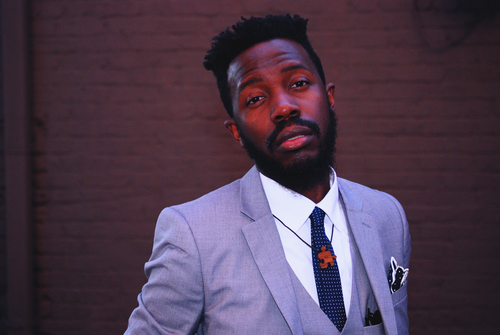
Photo by Yveka Pierre.

***
Pages Matam is a multidimensional touring artist, residing in the D.C. metropolitan area, but originally from Cameroon, Africa. He is author of Heart of a Comet (Write Bloody, 2014), a playwright, a 2014 National Poetry Slam champion and holds various other awards. His passions are in the field of education, violence and abuse trauma work, and youth advocacy. As a teaching artist with the national poetry non-profit Split This Rock, Pages is a coach for the DC Youth Slam Team. Pages is a proud gummy bear elitist, bowtie enthusiast, professional hugger and anime fanatic. When he takes stage -- as a performer, educator, or activist -- be prepared to be taken on an experience of cultural, socially conscious, and personal discovery unapologetic in its silly yet visceral and beautifully honest in its storytelling.  pagesmatam.com